Political Inequality
An emerging body of literature studies inequality in political influence between socioeconomic groups. This work usually finds that poorer citizens appear to exert lower political influence than richer citizens. Most of these studies have focused on formal, national-level policies, mainly in Western countries. How politically unequal are countries outside Europe and the US? What factors drive political inequality in these countries? And how much political inequality is there in the distribution of resources at the local level? We study these questions in the DFG-funded project Unequal Democracy in Brazil and South Africa.
Funder: DFG
Duration: 3 years
Marburg University team: Leticia Barbabela, Miquel Pellicer, Nils Strecker, and Eva Wegner
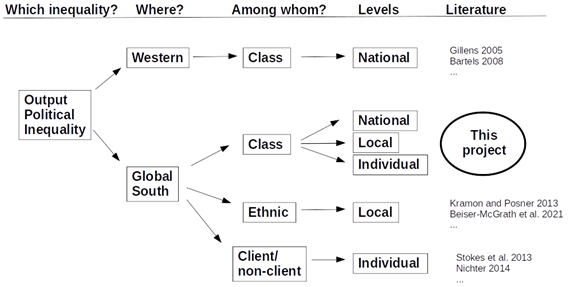
In this project we focus on inequality in political outputs (outputs that citizens receive from the political process, such as favored policies or allocation of government resources) across socioeconomic groups. An influential literature documents this type of inequality in the United States and European countries and argues that it is one of the drivers of economic inequality. To date, this literature has focused almost exclusively on Western countries and national-level outputs. At the same time, a large literature on clientelism and ethnic politics in the Global South documents inequalities in political outputs across ethnic groups and between clients and non-clients and emphasizes the importance of political outputs at the local (municipal budget allocations) or even individual level (particularistic benefits). We therefore study political inequality between socioeconomic groups in Brazil and South Africa – two countries with very high economic inequality – focusing on the national, local, and individual levels.
We measure political inequality at these three different levels and examine its drivers. We divide drivers of political inequality into immediate factors (inputs that citizens bring to the political process, such as voting, protesting, or lobbying) and contextual factors (factors that can drive variation in political inequality in time and space, such as political competition, term limits, or the nature of consultation processes). We measure the contribution of proximate drivers of political inequality using an Oaxaca-Blinder decomposition, and the contribution of contextual factors through regression and quasi-experimental analyses. These results are complemented by qualitative studies that analyze the mechanisms through which immediate and contextual factors affect political inequality.
Our project consists of three work packages (WPs) corresponding to the national, local, and individual levels. WP1 focuses on the national level: we collect and systematize existing surveys on preferences of richer and poorer citizen on proposed policies and match these preferences with data on which of these policies have been adopted. In WP2, we measure political inequality at the local level using data on municipal budget allocations in neighborhoods with different socioeconomic characteristics and examine the role of contextual factors. In WP3, we conduct a survey that collects data on the receipt of political benefits at the national, local, and individual levels, and a variety of political inputs at the different levels.